From Seasonal Gathering to Festival Programme: How Festivals Take Shape
See how a festival programme organises events, welcomes newcomers and signals what a gathering values, so you can choose an event that suits you.
What does a festival programme tell you about the gathering behind it? A spring fair might centre on a shared meal, while an arts festival makes its performances and venues easy to follow. The difference is not a simple story of tradition giving way to schedules; it is a matter of how each event chooses to express its purpose.
Custom and gathering
A recurring gathering can take shape around a local observance, anniversary or seasonal custom. Its order may be carried by familiar practices rather than a public timetable: a procession follows a known route, neighbours bring food, or music accompanies a dance people already recognise. These are examples of possible forms, not a universal account of how festivals began.
Such an occasion need not be unplanned. A ceremony may have a precise sequence, and participants may know their roles well. The distinction is whether that order is mainly held in shared practice or presented to visitors as timed events with listed locations.
Purpose and programme
A programme can make an event easier to understand, especially for people unfamiliar with its customs. It might identify a procession’s route, explain a ceremony or set out performances across several spaces. The choices also carry meaning: organisers decide what receives attention, what comes first and whether visitors are invited to participate, watch or learn.
Say a neighbourhood’s spring gathering has long centred on a shared meal. Imagine its organisers add a children’s procession, a local choir and a short explanation of the custom, with the meal still at the centre. Visitors who do not know the neighbourhood can then follow a clearer sequence, while the organisers must decide whether the added events support the gathering or distract from it.
Making a sequence
A schedule turns time into a visible structure. It can distinguish an opening from a central ceremony and show where audiences should go next. This helps visitors make choices, but it also creates practical demands: performers need agreed places and times, and organisers must account for transitions.
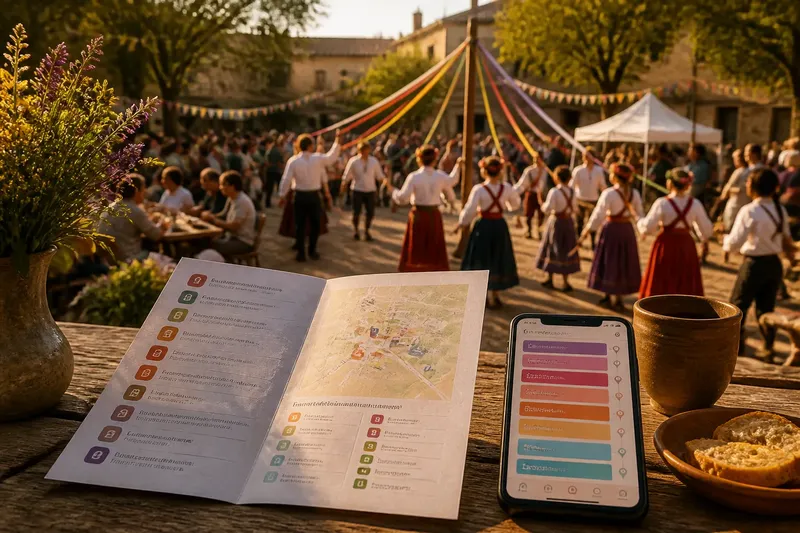
Paper programmes, noticeboards and festival apps each present information differently. A paper sheet can be passed between visitors and read without a phone connection. An app can carry updates and offer several views of a complicated schedule. For a clear plan, organisers can use both, while making sure that essential details such as venue changes appear in each format.
A programme can also bring different communities and activities together. The question is not only whether everything fits, but whether the event’s original purpose remains recognisable rather than becoming a backdrop for unrelated attractions.
Scale and stewardship
When an event welcomes people beyond its regular participants, organisers face cultural as well as logistical choices. They may need to explain a custom without taking it out of local hands, or invite visitors to join without turning participants into a spectacle.
A larger audience can create opportunities for artists and local crafts, but it can alter how an event works. A communal meal may become a ticketed service; a ritual route may change to manage crowds. Neither change has the same meaning in every setting, so the useful question is whether the arrangements still serve the festival’s stated purpose.
If participation is central, a schedule built mainly around watching may feel at odds with that aim. If the event is designed to present a curated arts programme, designated stages and clear timings may serve it well. A written programme does not, by itself, make a festival more or less traditional.
Reading a festival programme?
What is a festival programme?
It is an organised account of events, often listing times, places and descriptions. It also shows how organisers intend visitors to encounter the gathering.
Why do festivals use schedules?
Schedules help coordinate performers, venues and visitors, particularly when an event has several activities. They also make organisers’ priorities more visible.
Does a programme make a festival less traditional?
Not necessarily. A schedule can explain a custom and leave room for participation, though its choices may change how that custom is presented.
How can I identify a festival’s purpose?
Notice what anchors the programme, who takes part and where the event directs attention. A procession, shared meal, ceremony or set of performances can each suggest a different purpose.
Choices that reveal purpose
- If the central ceremony is open to everyone, the programme signals broad access; if it is restricted, check whether another activity offers a way to take part.
- If local participants are named as hosts, the programme recognises their role; if they appear only as performers, look for opportunities to learn about their contribution.
- If a shared custom anchors the schedule, it remains central to the day; if it sits between headline acts, consider whether the event presents it as a main purpose or an interlude.
- If the programme explains unfamiliar customs, visitors can follow their meaning; if it gives only times and venues, ask an organiser or consult a local information point.
- If the schedule includes opportunities to join in, visitors seeking participation have a clear route; if it is built around audiences watching, choose another event if that better suits your expectations.
- If paper and app listings agree, either can guide your day; if a venue change appears in only one, check the noticeboard or ask festival staff before setting off.
For instance, imagine you are choosing between two invented spring events. The first lists a communal meal as its central gathering and invites visitors to join a procession; the second centres on scheduled performances, with a local custom briefly described between them. If you want to take part in a shared observance, the first better fits that aim. If you want a sequence of performances, the second may suit you better. The trade-off is clear from the programme, without assuming that either event is more authentic.
Read a festival programme for more than its list of attractions. Notice what holds the day together, who is presented as host and how visitors are invited to participate. Those details help you decide whether the gathering’s purpose matches the experience you want, while leaving room for the possibility that a festival serves several purposes at once.